
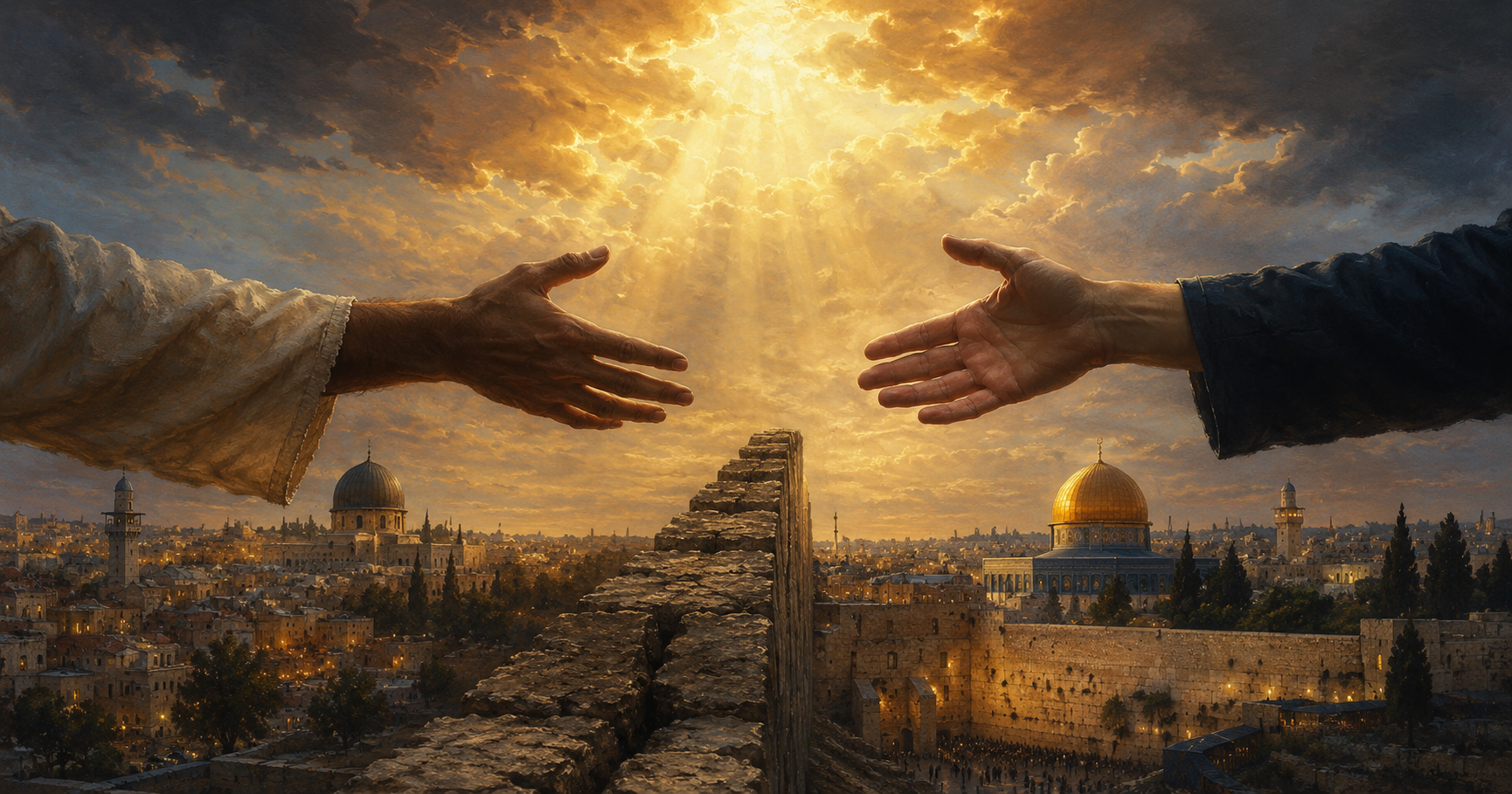
There is a wall that no treaty has been able to tear down.
Seventy-five years. Fourteen major peace initiatives. Zero lasting agreements. The conflict between Arab and Jew is the most negotiated dispute in modern history, and it is no closer to resolution today than the day it began. Not because the diplomats were not smart enough. Because what divides them was never land.
What the world calls the Arab-Israeli conflict is far older than the State of Israel. Its origins trace back millennia, rooted in territorial and cultural disputes over a region that is central to Judaism, Christianity, and Islam. The modern phase, usually dated to 1948, is only the most recent chapter in a story that has resisted every human attempt at resolution. Muslim tradition holds that whatever region becomes Muslim must remain Muslim, which means Israel is illegitimate on that basis in the eyes of many. On the other side, the Jewish claim to the land is inseparable from covenant theology, from a promise made by God to Abraham that no U.N. resolution has the authority to revoke or renegotiate.
These are not disputes that can be resolved by drawing borders differently. They go too deep. They touch identity, covenant, honor, and God.
What Diplomacy Has Proven
The history of peace negotiations between Arabs and Jews is a history of collapse. The Oslo Accords of 1993 and 1995 were designed to establish a framework for negotiating border disputes and creating Palestinian self-governance, yet they unraveled and left the region in a continued state of hostility and distrust. Neither the Madrid Conference of 1991, the Oslo Accords, nor the Camp David Summit in 2000 were able to realize a two-state solution, and each side blamed the other for the breakdown of negotiations.
This is not a failure of effort. Enormous political will, international pressure, and American mediation have been poured into this conflict for decades. The failure is not logistical. It is spiritual. The message of reconciliation through the blood of Christ offers not a political illusion, but a radical answer to what ultimately disturbs our peace.
No summit has ever put that on the table. And it is the only one that has been proven true on the ground.
The Wall Paul Was Writing About
The Apostle Paul wrote his letter to the Ephesians from a Roman prison, and he addressed something that made the Arab-Jewish conflict of his own day look familiar. Jews and Gentiles had been separated by more than culture. There was a literal stone barrier in the Jerusalem Temple, dividing the Court of the Gentiles from the inner courts. Inscriptions discovered by archaeologists warned that if a Gentile went beyond this barrier, he would have himself to blame for his death which followed. The separation was enforced with the threat of death.
Into that context, Paul wrote what remains the most radical statement of ethnic reconciliation ever recorded. Christ united Jews and Gentiles into one people when, in his own body on the cross, he broke down the wall of hostility that separated them. He made peace between Jews and Gentiles by creating in himself one new people from the two groups. Together as one body, Christ reconciled both groups to God by means of his death on the cross, and their hostility toward each other was put to death.
What Paul describes in Ephesians 2 is not an ideal. It is a completed act. The cross did not split the difference between Arab and Jew. It buried both and raised something neither had ever been.The Greek word for “new” in “one new man” means fresh or unused rather than chronologically new. Paul emphasizes the creative act of God in Christ that produces a new spiritual community distinct from either former group. Arab and Jew do not meet in the middle. They are both crucified and raised again in Christ. What emerges is neither.
Paul’s logic is that, because every kind of person is a sinner and at enmity with God, and because every kind of person is reconciled to God in the one Man, Jesus Christ, the hostility that once existed between those now reconciled to God must necessarily be done away with. To be reconciled to God, rightly understood, is also to be reconciled to one another.
What Is Already Happening
While the diplomats are still talking, something else is already happening in Jerusalem.
At Christ Church in Jerusalem, Jewish and Arab believers freely mingle, reflecting relationships built over time. The community has described its lifestyle as one of reconciliation, which is one of the main tenets of Jesus’ teachings, with staff comprising Jewish, Arab, and international believers who worship together in Hebrew, Arabic, and English as one body.
A Palestinian son of an imam received salvation in Jesus and did not sleep for three days afterward. He was crying, saying he had been living in a lie. His life was so changed that he wanted to tell everyone about Jesus, and despite the risk to his life, he began sharing the gospel on the streets of Gaza.
Jewish and Arab believers in the Messiah hold different national allegiances, but their first allegiance is to God and His Son. The whole concept of reconciliation is imperative for those who live together as brothers and sisters, believing in the same God, Bible, Messiah, and salvation that comes by grace from God.
These are not isolated stories. They are evidence of a pattern. Where Christ goes, the wall comes down.
What This Means for the Known by Name Israel
At KBN Israel, we see this conflict not from the vantage point of a think tank or a diplomatic summit. We see it from the streets. We see men from every background sleeping on the same pavement, eating from the same pot, carrying wounds that no peace process ever addressed. We work alongside ex-Muslims who have come to faith at enormous personal cost. We serve Jewish Israelis, Arab Israelis, foreign workers, and the forgotten of every nationality who end up on the margins of this city.
What we have learned is that the conflict is always personal before it is political. Hatred begins in a human heart, and it is only in the human heart that it can be killed.
Jesus is not a compromise position between Islam and Judaism. He is not a diplomat offering a two-state solution for the soul. He is the one Man in whom a new humanity has already been formed. Every person who genuinely comes to Him finds that the wall inside them has been brought down, not negotiated around. And when two people on opposite sides of the deepest conflict in the modern world discover that they are brothers in Christ, that is not a feel-good story. It is a sign that the Kingdom of God is advancing.
The political answer to this conflict has not come in over a century of trying. The answer that is already working is the one the world keeps dismissing. His name is Jesus, and He is at work on these streets.